I Ching and Feng Shui
The I Ching divination tool as the foundation of Feng Shui
Dec 2, 2021

I Ching and Feng Shui
The I Ching, which translates to The Classic Book of Changes, is one of the oldest known Chinese texts of philosophy and divination, and the most well-known classical Chinese book of wisdom alongside the Tao Te Ching.
The I Ching has influenced numerous ancient philosophies and disciplines, including Feng Shui. Conveying the rhythms and laws of the Universe in a specific structure of 64 hexagrams (six-line combinations), this ancient text brings awareness and guidance to understanding human actions, desires, and the inevitable nature of change.
The author of the I Ching is considered to be Fu Hsi, who is somewhat of a mythical figure in Chinese history. It is purported that he lived in 2800-2737 BC; and that he discovered the eight trigrams (three-line combinations) of the Feng Shui Bagua by reading the shapes on the back of a turtle. These lines are yin and yang in nature placed in different orders to represent different aspects of nature. You can see how these associate with different elements below.
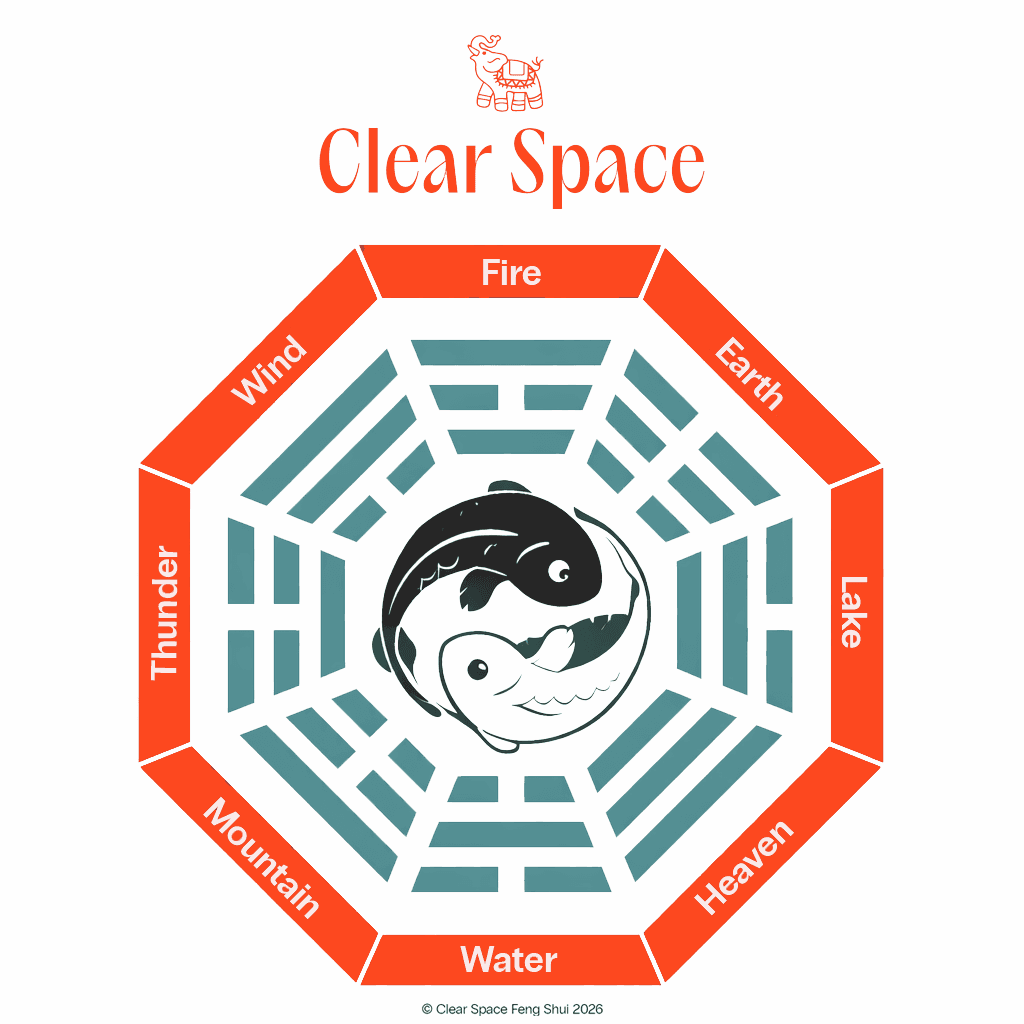
The eight initial trigrams later developed into 64 hexagrams, which are sets of six lines expressing the yin and yang nature of any energy, be it an event, a person, or an intended action. The Yang energy is represented by solid, unbroken lines and the Yin is shown in lines with an opening in the middle. Through deciphering this “binary code” of Yin and Yang, wonderful life guidance arises when it is most needed.
The I Ching is considered essential to consult during life’s crossroads. I like to use the I Ching to see how a person’s personal Gua number will interact with the inherent Gua number of a building, giving an insight into how the chapter of living or working in a space will feel for my client.
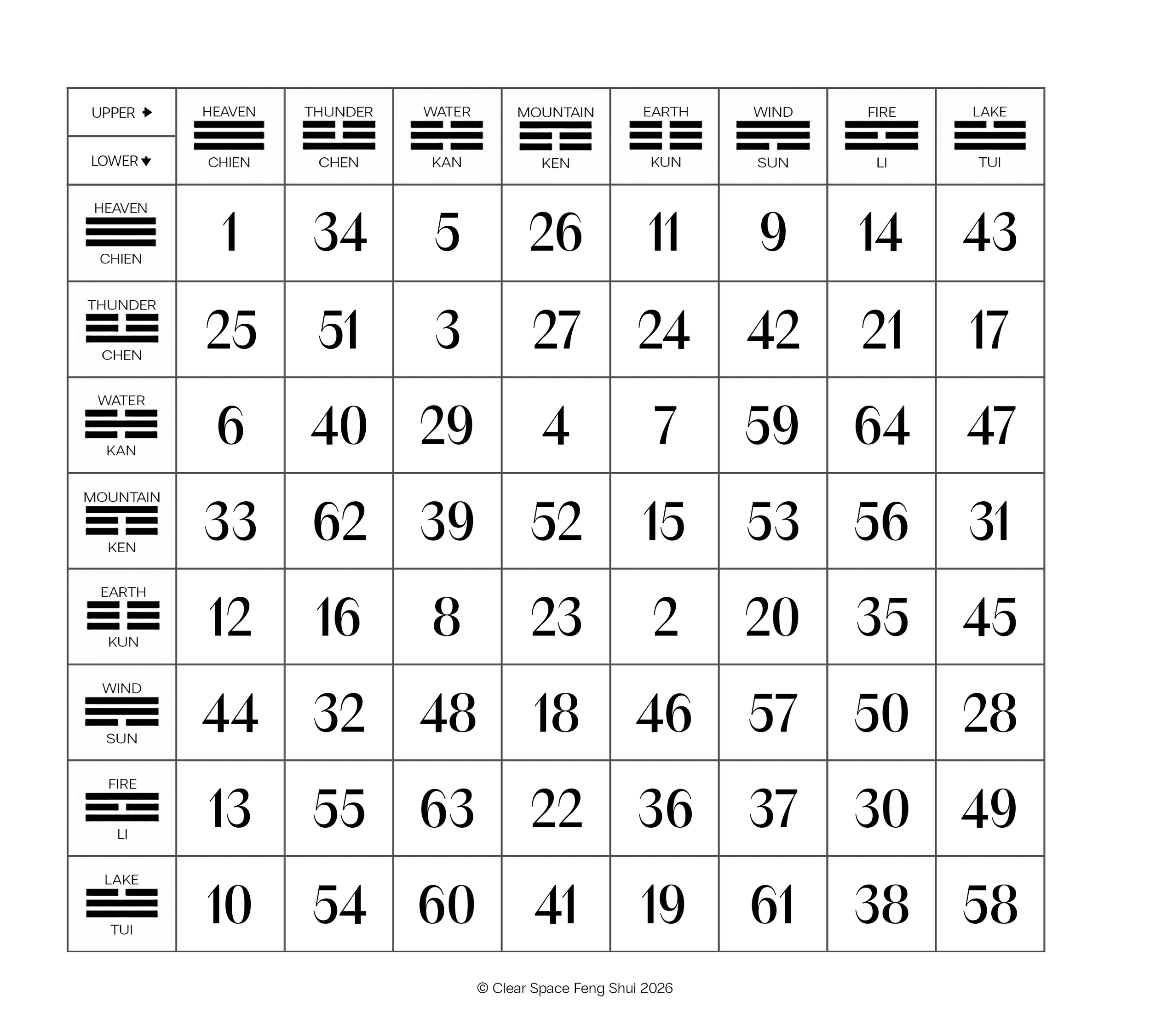
Below is a diagram and a quick summary of the meaning of each of the 64 combinations.
Want to see how an I Ching reading can give you more insight about your space? Book a free call to see how Feng Shui can work for you.
I Ching Summary
Here is a summary of the different meanings of each of the 64 I Ching readings.
1. Ch'ien / The Creative: Represents the ultimate creative force and signifies success through determination, initiative, and strong leadership.
2. K'un / The Receptive: Symbolizes receptivity and yielding, emphasizing the power of patience, adaptability, and nurturing to achieve harmony and success.
3. Chun / Difficulty at the Beginning: Indicates challenges and obstacles at the outset, advising perseverance and careful planning to overcome initial difficulties and achieve eventual success.
4. Meng / Youthful Folly: Warns against impulsive actions and immature decisions, suggesting the need for prudence and self-discipline to avoid setbacks.
5. Hsu / Waiting (Nourishment): Advises patience and contemplation in a period of waiting, emphasizing the importance of preparation and inner development for future success.
6. Sung / Conflict: Portrays a time of tension and conflict, urging the resolution of disputes through open communication, compromise, and diplomacy to avoid long-term damage.
7. Shih / The Army: Represents a disciplined and organized approach to challenges, emphasizing strategic planning, unity, and cooperation to achieve success in endeavors.
8. Pi / Holding Together (Union): Highlights the strength of unity and cooperation, suggesting that collective efforts and mutual support lead to success and stability.
9. Hsiao Ch'u / The Taming Power of the Small: Emphasizes the influence of small, gradual efforts in bringing about positive change, advocating patience and persistence in the face of challenges.
10. Lü / Treading (Conduct): Encourages careful and deliberate actions, stressing the importance of ethical conduct and prudence in navigating life's paths to ensure long-term success.
11. T'ai / Peace: Signifies a time of tranquility and harmony, promoting balance, diplomacy, and cooperation to maintain peace and stability.
12. P'i / Standstill (Stagnation): Indicates a period of stagnation and standstill, advising introspection, patience, and the elimination of obstacles to break free from inertia and move forward.
13. T'ung Jên / Fellowship with Men: Emphasizes the power of harmonious relationships and mutual understanding, suggesting that collaboration and cooperation with others lead to success and fulfillment.
14. Ta Yu / Possession in Great Measure: Signifies abundance and prosperity, cautioning against complacency and the responsible management of resources for sustained success.
15. Ch'ien / Modesty: Encourages humility and modesty, emphasizing the value of self-awareness and the avoidance of arrogance to foster positive relationships and personal growth.
16. Yü / Enthusiasm: Symbolizes a time of high energy and enthusiasm, advising the channeling of this energy into productive endeavors and the avoidance of reckless actions.
17. Sui / Following: Recommends adaptability and humility, suggesting that success lies in aligning oneself with the prevailing circumstances and following a path of least resistance.
18. Ku / Work on what has been Spoiled (Decay): Represents the need for addressing and rectifying issues, emphasizing the importance of timely intervention to prevent further deterioration and promote renewal.
19. Lin / Approach: Advises a gradual and cautious approach to challenges, highlighting the importance of careful preparation and attention to detail for long-term success.
20. Kuan / Contemplation (View): Encourages introspection and thoughtful observation, suggesting that clarity of perception and a deep understanding of situations lead to wise decisions and success.
21. Shih Ho / Biting Through: Signifies the need for decisive action and determination in overcoming obstacles, emphasizing the power of persistence and the courage to confront challenges head-on.
22. Pi / Grace: Represents the power of attractiveness and charm, suggesting that cultivating positive relationships and graciousness lead to success and favorable outcomes.
23. Po / Splitting Apart: Indicates a time of separation and disintegration, advising careful handling of conflicts and the need for constructive solutions to prevent lasting damage.
24. Fu / Return (The Turning Point): Symbolizes a turning point or transition, emphasizing the importance of adapting to changing circumstances and seizing opportunities for renewal and progress.
25. Wu Wang / Innocence (The Unexpected): Represents a state of innocence and spontaneity, advising openness to new experiences and the ability to adapt to unexpected situations for personal and spiritual growth.
26. Ta Ch'u / The Taming Power of the Great: Signifies the influence of powerful forces, urging the cultivation of inner strength, humility, and adaptability to navigate challenges successfully.
27. I / The Corners of the Mouth (Nourishment): Highlights the importance of nourishing oneself and others, emphasizing balanced and sustainable approaches to achieve well-being and success.
28. Ta Kuo / Preponderance of the Great: Signifies the dominance of powerful forces, advising the cultivation of inner strength, caution, and adaptability to navigate challenges successfully.
29. K'an / The Abysmal (Water): Symbolizes a time of uncertainty and danger, advising flexibility, adaptability, and careful navigation to overcome obstacles and avoid setbacks.
30. Li / The Clinging (Fire): Represents a time of clinging and attachment, advising the need for moderation and awareness to avoid excessive desires and maintain balance.
31. Hsieh / Influence (Wooing): Signifies the power of influence and attraction, advising the careful use of charisma and diplomacy to achieve positive outcomes in relationships and endeavors.
32. Heng / Duration: Emphasizes the importance of persistence and endurance, suggesting that long-term success requires patience, determination, and the ability to weather challenges.
33. Tun / Retreat: Advises strategic withdrawal and reflection, emphasizing the importance of regrouping and reassessing in order to advance more effectively in the future.
34. Ta Chuang / The Power of the Great: Represents the potential for great power and influence, advising responsible and ethical use of such power for the benefit of all.
35. Chin / Progress: Signifies steady progress and advancement, advising a disciplined and focused approach to achieve success through continuous effort and improvement.
36. Ming I / Darkening of the Light: Indicates a time of confusion and uncertainty, advising the cultivation of inner clarity, caution, and patience to navigate challenges successfully.
37. Chia Jên / The Family (The Clan): Emphasizes the importance of family and community, suggesting that nurturing positive relationships and fostering cooperation lead to lasting success and fulfillment.
38. K'uei / Opposition: Symbolizes a time of opposition and conflict, advising the cultivation of diplomacy, flexibility, and compromise to navigate challenges successfully.
39. Chien / Obstruction: Represents obstacles and challenges, advising perseverance, adaptability, and strategic thinking to overcome barriers and achieve success.
40. Hsieh / Deliverance: Signifies liberation from difficulties, advising the need for patience, careful planning, and the alignment of intentions with higher principles to achieve freedom and success.
41. Sun / Decrease: Indicates a time of decrease and reduction, advising a prudent and frugal approach to preserve resources and navigate challenges successfully.
42. I / Increase: Signifies a time of increase and growth, advising responsible management of resources and the need for a balanced and ethical approach to achieve sustained success.
43. Kuai / Break-through (Resoluteness): Represents a time of breakthrough and decisive action, advising boldness, determination, and resilience to overcome obstacles and achieve success.
44. Kou / Coming to Meet: Advises a receptive and open attitude, suggesting that success comes through adaptability, cooperation, and the ability to meet challenges with a positive mindset.
45. Ts'ui / Gathering Together (Massing): Symbolizes the power of collective unity, advising the consolidation of resources and efforts for a common goal, fostering strength through collaboration.
46. Shêng / Pushing Upward: Represents a time of growth and upward momentum, advising a proactive and determined approach to overcome obstacles and achieve progress.
47. K'un / Oppression (Exhaustion): Indicates a period of oppression and exhaustion, advising patience, inner strength, and careful planning to endure difficulties and facilitate renewal.
48. Ching / The Well: Emphasizes the importance of inner clarity and sincerity, suggesting that genuine communication and alignment with higher principles lead to lasting success.
49. Ko / Revolution (Molting): Signifies a time of radical transformation, advising adaptability, courage, and openness to change to navigate challenges successfully.
50. Ting / The Caldron: Represents a situation of stability and nourishment, advising the cultivation of inner strength, ethical conduct, and the responsible use of power for positive outcomes.
51. Chên / The Arousing (Shock, Thunder): Symbolizes a time of awakening and sudden change, advising a proactive and alert approach to respond effectively to emerging opportunities and challenges.
52. Kên / Keeping Still (Mountain): Indicates a time of stillness and contemplation, advising patience, reflection, and the cultivation of inner strength to endure difficulties.
53. Chien / Development (Gradual Progress): Emphasizes the importance of gradual progress and development, advising patience, perseverance, and a disciplined approach to achieve long-term success.
54. Kuei Mei / The Marrying Maiden: Signifies the union of complementary forces, advising adaptability, patience, and mutual respect in relationships to achieve harmony and success.
55. Fêng / Abundance (Fullness): Represents a time of abundance and prosperity, advising the responsible management of resources and the cultivation of gratitude to ensure lasting success.
56. Lü / The Wanderer: Indicates a time of wandering and exploration, advising openness to new experiences, adaptability, and the cultivation of inner strength to navigate uncertainties successfully.
57. Sun / The Gentle (The Penetrating, Wind): Emphasizes the power of gentleness and flexibility, advising a non-confrontational approach and adaptability to achieve success in various situations.
58. Tui / The Joyous (Lake): Signifies a time of joy and celebration, advising the cultivation of positive relationships, gratitude, and a lighthearted approach to life for lasting fulfillment.
59. Huan / Dispersion (Dissolution): Indicates a time of dispersal and transition, advising adaptability, careful planning, and the alignment of intentions with higher principles for positive outcomes.
60. Chieh / Limitation: Emphasizes the importance of setting limits and boundaries, advising a disciplined and balanced approach to avoid excesses and achieve long-term success.
61. Chung Fu / Inner Truth: Represents the discovery of inner truth and authenticity, advising honesty, self-reflection, and alignment with one's true values for lasting success.
62. Hsiao Kuo / Preponderance of the Small: Signifies the influence of small, gradual efforts, advising patience, persistence, and attention to detail for long-term success.
63. Chi Chi / After Completion: Indicates a time of completion and fulfillment, advising the recognition of achievements, gratitude, and careful planning for the next phase of growth.
64. Wei Chi / Before Completion: Represents a time of anticipation and preparation for completion, advising caution, attention to detail, and strategic planning to ensure a successful conclusion.


Faq
Your questions answered
Still have more questions? Send us an email: info@clearspacefengshui.com We are here to help!
What is Feng Shui and how does it work?
Feng Shui is an ancient Chinese system for arranging spaces to improve balance, harmony, and well-being. It examines how layout, furniture placement, color, and environmental elements influence the flow of energy (chi) and how that energy affects daily life, health, relationships, and prosperity.
Is Feng Shui a religion?
No. Feng Shui is not a religion. It is a practical design and energy-based system rooted in observation of nature and environmental patterns. Feng Shui can be practiced alongside any spiritual belief system -- or none at all.
What are the benefits?
Feng Shui helps improve the function and energy flow of homes, offices, and commercial spaces. Clients often experience greater clarity, vitality, productivity, and emotional ease after implementing Feng Shui recommendations. Feng Shui can also support positive shifts in relationships, financial flow, and overall harmony.
What happens during a session?
Our flagship offering begins with a conversation about your goals and how you use your space. Customized energetic maps of your home or business are prepared in advance, using Classical Feng Shui systems, including the Bagua, Eight Mansions (Ba Zhai), Flying Star Feng Shui, and incorporating your own personal Ming Gua lucky directions. During the session, we review your floor plan and walk through each area with specific recommendations for layout, furniture placement, color, elemental, and energetic balance. After the consultation, you receive a detailed written summary and a follow up email with relevant links or items to incorportate. In-person consultations also include a space clearing and energetic reset. Sessions are equally effective whether conducted in person or virtually.
Do you offer virtual sessions?
Yes, virtual Feng Shui consultations are available worldwide. Upload your floor plan and photos in advance, and Susan will guide you through personalized Feng Shui adjustments as if you were working on-site.
What types of spaces do you work with?
Residential homes, apartments, offices, studios, and commercial spaces. Susan also also collaborates with developers, architects, and designers on pre-construction Feng Shui reviews to support optimal flow, comfort, and long-term value from the planning stage.
How should I prepare for my Feng Shui session?
Before your consultation, please share your floor plan, address, and birthdates (used to calculate lucky directions) at least one week in advance. It’s also helpful to consider which areas of life you’d like to support, such as health, relationships, career, or finances. If you don’t have a floor plan, an easy-to-use tool will be provided to help you create one. Other than that, leave your place how it usually is! It is best for Susan to see how you are authentically using your space.
How soon will I notice results?
Some clients notice shifts in energy and clarity immediately, while others experience gradual changes over weeks or months. Results depend on consistency and how fully the recommendations are implemented. Many clients report long-term improvements as the space continues to support them.
Can Feng Shui help a home sell faster?
Yes. Feng Shui can make a home feel more welcoming, balanced, and emotionally appealing to buyers. Feng Shui for selling, combined with space clearing, can help refresh a property’s energy and support a smoother, more aligned sales process.